
AI can reduce the time required to produce a first draft of code, documentation, or a test. That does not automatically reduce the cost of delivering a dependable product. For Pakistani software companies, the useful question in 2026 is where saved effort goes and whether the buyer receives better value.
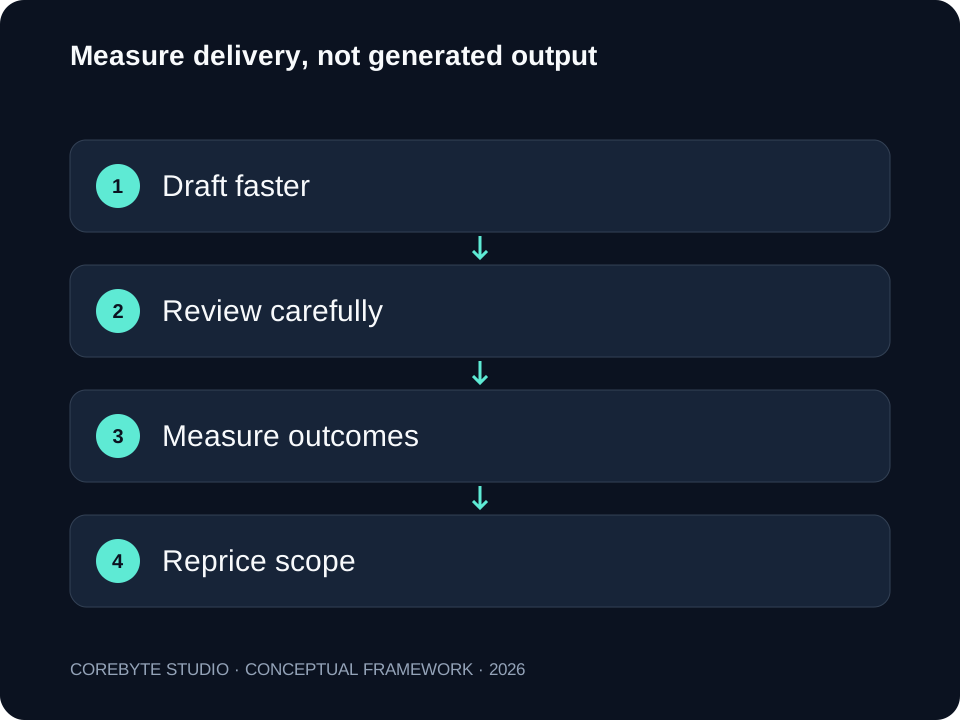
Separate code production from product delivery
A generated interface may look complete while authentication, error handling, and data migrations remain unresolved. Count the whole path from requirement to accepted, supported behaviour. A faster first draft is valuable, but it is only one component of that path.
NIST’s AI Risk Management Framework provides voluntary guidance for incorporating trustworthiness into AI systems. Our practical application for a service team is narrower: name who reviews the output, decide what data the tool may receive, and define the evidence needed before work reaches a client.
Sources: NIST AI Risk Management Framework ↗
Establish a measured baseline
Select a repetitive, bounded task such as adding a conventional API endpoint. Compare similar changes with and without assistance, including review time and defects found after acceptance. Do not infer company-wide productivity from one unusually successful demonstration.
If implementation time falls but review time rises, investigate why. The generated solution may be unfamiliar, overcomplicated, or weak on edge cases. Improve the brief and reuse established patterns before claiming a permanent efficiency gain. The goal is reduced total delivery effort at an acceptable quality level.
Revisit the commercial promise
Hourly work needs transparent discussion about how assistance affects delivery and billing. Fixed-price work still needs a clearly defined outcome and a change process. In either model, avoid charging for fictional hours or promising that all future changes will now be almost free.
An illustrative buyer comparison is useful: one provider offers a cheap prototype with no operational ownership, while another includes permissions, migration, monitoring, and handover. The outputs may look similar during a demo. The scope and cost of responsibility are different. Make those differences visible in the proposal.
Redesign junior learning rather than removing it
If juniors only accept generated code, they lose practice identifying cause and effect. Ask them to explain the request flow, change a rule, and diagnose a failed test. Use AI to prepare examples and reduce repetitive setup while preserving the learning that builds independent judgment.
Seniors also need discipline. Reviewing a large generated change after a long day is a poor control. Keep changes small and require specific acceptance evidence. A human name on an approval is useful only when that person had enough context and time to assess it.
Create an AI usage policy clients can understand
Explain which tools are used, what information may enter them, and how output is checked. Client data and proprietary code require an agreed handling approach. Record tool decisions where they affect confidentiality, maintenance, or contractual obligations.
Review the policy when tools or client requirements change. Avoid marketing universal productivity percentages. A stronger proposition is concrete: faster bounded work, explicit review, and observable delivery quality. That promise can be evaluated on a real engagement.
Put this into practice
- Measure implementation, review, and correction together.
- Approve tools and data handling for each client.
- Keep generated changes small enough to review.
- Preserve juniors’ debugging and explanation practice.
- Describe the actual scope behind an AI-assisted price.
Frequently asked questions
Does AI mean software development should always cost less?
No. It can reduce parts of implementation effort, but discovery, security, review, operation, and support remain part of the cost.
Should clients know that a team uses AI tools?
Use a clear agreement where tool use affects confidentiality, intellectual property, deliverables, or billing. Explain the review and data-handling process.