
Security becomes easier to assess when a team can show how access is granted, how changes are reviewed, and how an incident would be contained. For a Pakistani software house serving local or international buyers, these controls are part of delivery quality and client trust.
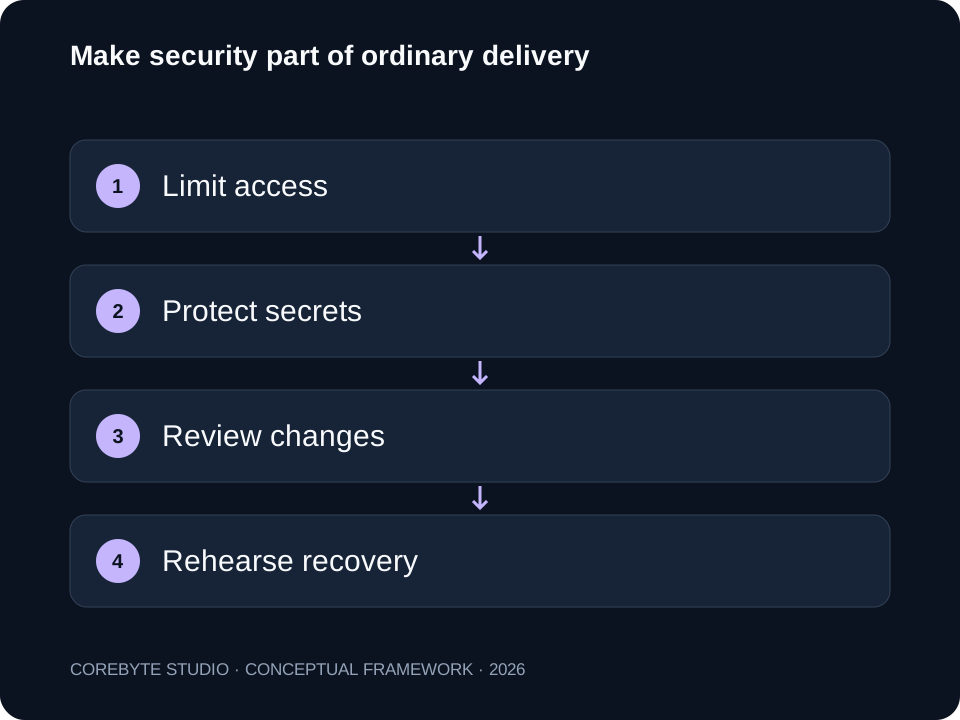
Start with assets and access
Identify source repositories, production accounts, client information, credentials, and backups. Record who owns each system and who needs access. Use individual identities and remove access when responsibilities change. A shared administrator password makes accountability and revocation difficult.
OWASP’s Top 10 provides an awareness reference for important web application security risks; its current released edition is 2025. It is a starting point for review, not a certification or a complete guarantee that an application is secure. Match additional controls to the system’s data and consequence.
Sources: OWASP Top 10 — current web application security guidance ↗
Protect secrets throughout development
Keep credentials out of source control and sample files. Provide synthetic development data wherever possible. Restrict production access to the people and systems that require it. Make sure logs and error reports do not accidentally include tokens or private records.
If a secret is exposed, removing it from the latest commit is not enough. Rotate it, investigate use where feasible, and address how it entered the repository. Preserve the relevant incident evidence without redistributing the secret. A cleanup that leaves the credential active has not contained the risk.
Verify permissions on the server
A hidden button is not an access control. Check authorisation for sensitive operations and data access on the server. In multi-tenant software, test that one organisation cannot read or change another organisation’s records by modifying an identifier.
Use negative cases in review: an unauthenticated request, a user with the wrong role, an expired session, and a request targeting another tenant. These tests examine promises that ordinary UI demonstrations miss. Record the expected rejection as part of acceptance evidence.
Review dependencies and release paths
Keep dependencies and build configuration visible to reviewers. Understand what a new package adds and whether it is maintained appropriately for the project. A passing installation does not establish that a dependency is trustworthy. Apply updates through a repeatable process with suitable validation.
Protect deployment credentials and restrict who can change release settings. Where the project warrants it, require an independent review before production changes. Keep a record of what shipped and how to revert it. The objective is to reduce the chance that one mistaken action becomes an untraceable production change.
Rehearse a small incident
Choose an exercise such as a suspected stolen credential. Identify who can revoke access, inspect activity, contact the client, and restore service. Test whether the instructions and account permissions actually work. A policy file is weaker evidence than a successful exercise.
For buyers, ask to inspect process evidence without requesting sensitive secrets or private client data. For providers, state limitations honestly and obtain specialist assessment where the risk requires it. Security credibility comes from specific, maintained controls rather than a claim that the platform is completely secure.
Put this into practice
- Inventory production systems and access owners.
- Use individual accounts and prompt revocation.
- Keep secrets and real client data out of development fixtures.
- Test cross-role and cross-tenant rejection.
- Rehearse credential revocation and client escalation.
Frequently asked questions
Does the OWASP Top 10 certify an application?
No. It is an awareness reference that helps guide security work. It does not replace risk-based review or independent testing when needed.
Is deleting an exposed key enough?
No. Rotate or revoke the key and investigate potential misuse. Also fix the process that allowed the exposure.