
Your first engineering job requires more than a collection of completed courses. This roadmap uses a single project to develop the habits of professional delivery: planning, implementation, review, deployment, and honest communication. The 90 days are a planning framework, not a guaranteed time to employment.
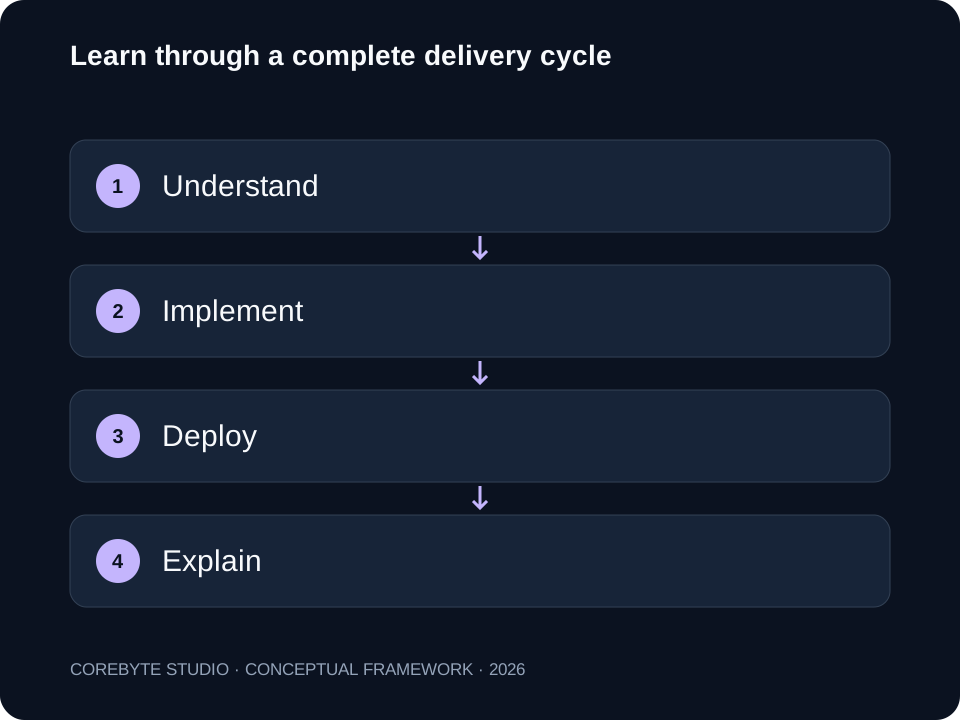
Days 1–15: define a small problem
Choose a project whose users and rules you can understand. A booking tool for a small training centre is enough. Write down who creates sessions, who books them, how capacity is enforced, and how cancellations work. Exclude payments and sophisticated analytics from the first release unless they are central to the problem.
Draw the data model and list the five most important behaviours. Learn enough Git to create branches, inspect differences, and undo a mistaken change safely. Keep notes on what you do not understand. A visible question list is more useful than pretending the architecture is already settled.
Days 16–40: implement the important rules
Build the flow from input to stored record before polishing the dashboard. Add validation on the server, role checks, and clear error messages. For bookings, test whether two concurrent requests can exceed capacity. The difficult rule is usually more educational than the prettiest screen.
Use the existing conventions of your chosen stack. Read its official documentation when behaviour is unclear. If AI suggests an unfamiliar package or pattern, verify why it is needed. Learn to distinguish a plausible explanation from an implementation you can actually reason about.
Days 41–60: make the project operational
Deploy to an environment you can afford and configure secrets outside version control. Add useful logging without recording passwords or sensitive user data. Create a small backup and restore exercise using synthetic records. A successful deployment is not the end of operational learning.
Ask a friend to use the application without coaching. Observe where they hesitate or encounter errors. Prioritise problems that prevent completion before cosmetic refinements. Record one change that resulted from feedback so you can show how evidence influenced the project.
Days 61–75: review and reduce uncertainty
Review the code for duplicated rules, missing permissions, and unclear data boundaries. Write meaningful tests for capacity, cancellations, and access. Avoid a large suite that only repeats the code’s own assumptions. The test should fail if an important user promise breaks.
Invite a more experienced developer to review a small, focused change. Send the intended behaviour and the decision you are unsure about. A precise question respects the reviewer’s time and produces more useful feedback than asking them to inspect an entire repository without context.
Days 76–90: prepare a credible interview package
Create a short walkthrough: the user problem, a live demonstration, one technical trade-off, and one failure you fixed. Explain what you would improve if more users arrived. Keep the repository organised enough that a hiring engineer can reproduce the project.
Pair the project with a concise CV and targeted applications. If you work full-time or have limited connectivity, stretch the schedule rather than sacrificing understanding. The milestone is a system you can explain and maintain. Completing it in exactly three months is less important than being truthful about what you learned.
Put this into practice
- Write five acceptance behaviours before building.
- Implement server validation and access checks.
- Deploy using synthetic data and protected secrets.
- Get uncoached user feedback and a focused code review.
- Prepare one trade-off and one debugging story.
Frequently asked questions
Do I need an expensive bootcamp for this roadmap?
No. A focused project, official documentation, and useful feedback can support the plan. Paid instruction helps only when it resolves a specific learning need.
Should I learn several stacks at once?
For a first portfolio project, use one stack through deployment. Add breadth after you can explain the complete lifecycle.