
A distributed engagement succeeds when the client and delivery team agree on how work becomes accepted software. Location alone does not establish quality. When working with a Pakistani software team in 2026, evaluate the operating agreement and evidence with the same care as the portfolio.
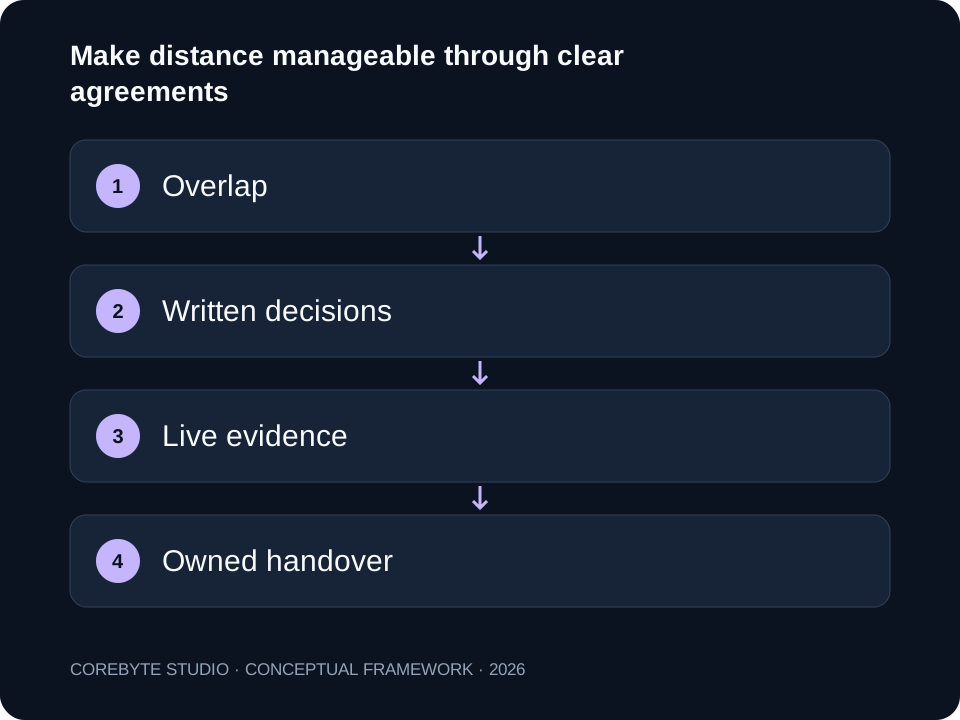
Agree on time-zone overlap before kickoff
Pakistan uses UTC+5. Choose a shared window based on the client’s actual location and working pattern, then account for daylight-saving changes on the client side. Specify which meetings require attendance and which updates can be read asynchronously.
Avoid making immediate availability the default proof of commitment. If the project needs extended incident coverage, budget and staff it explicitly. A development team working normal hours and an on-call support service are different arrangements. The proposal should make that distinction clear.
Give the project a decision route
Identify the person who can approve scope and the person who can resolve technical questions. The two may be different. Record decisions in a durable location instead of distributing them across calls, private messages, and screenshots.
A useful decision note states the question, options, chosen approach, owner, and consequence. For example, choosing a manual import for the first release may shorten the schedule while creating an operational task. The client should understand that trade-off before the feature is called complete.
Review working behaviour early
Ask for short demonstrations of the actual workflow with representative, non-sensitive data. A design preview can validate layout; it cannot demonstrate permissions or integration reliability. Decide which evidence is appropriate for each stage.
For a stock system, review an ordinary transfer, a rejected transfer, and an authorised reversal. This reveals more than a tour of every dashboard screen. Raise problems while the implementation is still small enough to change economically. Early evidence reduces the cost of distance.
Keep ownership and access explicit
Clarify repository ownership, hosting accounts, third-party subscriptions, and administrative access. Use individual accounts and appropriate permissions rather than shared passwords. Agree how credentials are issued and revoked when people leave the engagement.
The buyer should be able to identify where the application runs, how releases happen, and who can restore service. These are reasonable acceptance concerns for any provider. A low implementation quote loses meaning if the buyer must later pay to regain access or reconstruct operational knowledge.
Define a handover that another team can use
Require setup instructions, deployment notes, a configuration inventory without secret values, and a list of known limitations. Include a demonstration of recovery or rollback appropriate to the system. Match the documentation effort to the product’s consequence and complexity.
At CoreByte Studio, we recommend discussing these expectations before the build. The handover should emerge from ordinary delivery artifacts rather than a rushed document at the end. A reliable engagement makes both progress and responsibility visible throughout the work.
Put this into practice
- Choose a realistic overlap window using both time zones.
- Name commercial and technical decision owners.
- Review successful and failed workflow examples.
- Keep accounts, repositories, and access ownership clear.
- Specify documentation and recovery evidence before delivery.
Frequently asked questions
How much overlap does a remote project need?
There is no universal number. Agree on enough overlap to resolve decisions and review work, then use written updates for the rest.
Should a client own the cloud account?
Account ownership should be explicit in the contract. For client-specific products, client-controlled accounts often simplify continuity and access management.