
Pakistan’s software industry is not one uniform market. A graduate seeking a first role, a services exporter, and a local SaaS founder face different constraints. This closing guide connects the series into an action plan focused on choices a team can control rather than predictions it cannot verify.
Use dated evidence and resist a single national story
The Pakistan Economic Survey 2025–26 is an official entry point for industry context. Its reporting period and categories matter. Use it alongside evidence from your own customers and team. A favourable sector-level signal does not remove a local problem with payment, recruitment, or delivery quality.
When an article claims that AI has eliminated jobs or that every software company is growing, ask which sample and period support the statement. Separate observed data, interpretation, and recommendation. In this series, operating frameworks and hypothetical examples are advice rather than measured national outcomes.
Sources: Pakistan Economic Survey 2025–26 — official chapter index ↗
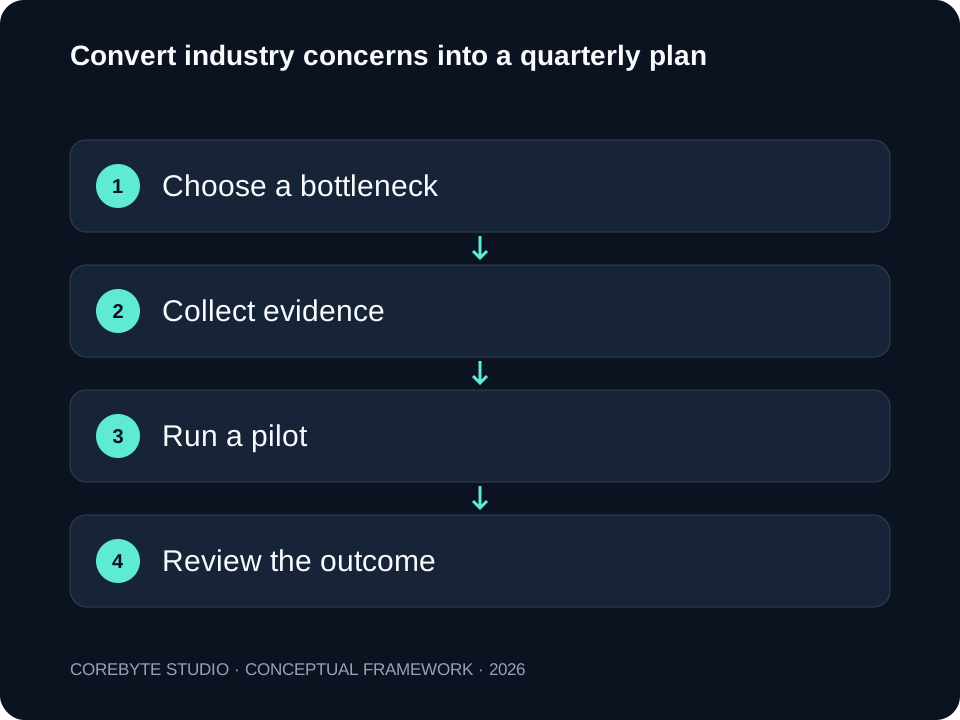
Identify the business constraint you can influence
Review the path from lead to collected payment. Which stage produces the longest delay or largest avoidable loss? A company with many leads and weak conversion needs a different intervention from one with signed work and unreliable delivery. Choose the constraint using actual records.
For a SaaS founder, the equivalent path is prospect, onboarding, repeated use, and renewal. For a job seeker, it is targeting, response, assessment, and offer. The industry conversation becomes useful when it points to a specific stage that needs improvement.
Turn the constraint into a bounded experiment
Write a short experiment brief with an owner, baseline, change, measurement, and review date. If invoices are delayed by acceptance disputes, try a clearer milestone demonstration and documented review window on the next suitable engagement. Track whether the delay changes.
Avoid changing sales, pricing, staffing, and technology simultaneously unless urgency requires it. Too many changes make the result hard to interpret. A smaller experiment gives the team a clearer reason to repeat, revise, or stop the approach.
Build capability without creating permanent overload
Make learning and process improvement part of working capacity. A team cannot adopt better review, security, and customer discovery if every hour is already promised to a deadline. Decide which existing work will be reduced or postponed to make the improvement possible.
For a 30-day example, choose one role to train in a recurring support issue, document the response, and test it with supervision. This builds distributed responsibility while preserving quality. A tool subscription without the time to use and assess it is not a capability plan.
Review business outcomes and keep the next step concrete
At the end of the cycle, compare the baseline with the observed outcome and state limitations. If only one engagement used the new process, treat the result as provisional. Record what changed and what evidence would justify broader adoption.
CoreByte Studio’s recommendation is to invest in the chain that earns trust: clear scope, observable delivery, responsible operations, and continuity after release. A stronger industry is built through repeated, credible outcomes. Start this quarter with one constraint, one owner, and one reviewable improvement.
Put this into practice
- Use original sources with explicit reporting periods.
- Identify the weakest stage in your own operating records.
- Define one experiment with an owner and baseline.
- Reserve capacity for the change before committing to it.
- Review the observed result and its limitations.
Frequently asked questions
What is the biggest challenge for every Pakistani software company?
There is no single universal constraint. Identify yours through customer, delivery, hiring, and cash records instead of assuming a national headline describes your business.
How should I use this blog series?
Choose the article closest to your current bottleneck, apply its checklist to one bounded engagement, and review the outcome before expanding the change.